Opening: April 17 at 6:00 PM
Installation duration: April 18, 2026 – June 28, 2026
Venue: Beckov Castle
Free entry for the opening.
Admission from April 18 to June 28 is included with a regular visit to Beckov Castle (according to the castle’s current visiting schedule and price list).
There are at least 307 different ways to use a piano. It is not necessary to list them all; for now, a few examples will suffice:
-
the piano as a loudspeaker
-
the piano as a sculpture
-
the piano recycled
-
the piano catching the wind
-
the piano in dialogue with the landscape
The third edition of the úúú series of sound events, part of Trenčín 2026, explores the possibilities of the piano that no longer serves as a musical instrument but has acquired several new functions. One of them is its transformation into a monumental wooden loudspeaker placed above the landscape near Nové Mesto nad Váhom.
We find ourselves at the intersection of sound art, sculpture, and land art. Here, Canadian composer and sound-installation artist Gordon Monahan further develops his long-standing interest in the physicality of sound and the exploration of natural laws, which he re-creates using human-made objects.
The piano—now a sound object—becomes the carrier of its own sonic trace; at the same time, it interacts with the landscape and the weather, naturally amplifying and recomposing their sounds.
Gordon Monahan (CA): Piano Listening to Itself at Beckov Castle
Sound installation / 2026
An old concert grand piano is placed at the top of Beckov Castle. Positioned on the highest terrace of the fortress, it transforms from an instrument into a sound object. Dozens of meters of stretched strings connect the piano to the castle walls. Through them, decomposed piano recordings are transmitted into the instrument. The strings begin to vibrate and the piano’s soundboard resonates—turning the piano into an unusual acoustic loudspeaker.
Additional sounds, known as aeolian tones, arise from the action of the wind on the extended strings. A spontaneous acoustic composition emerges, in which piano music intertwines with atmospheric harmonies.
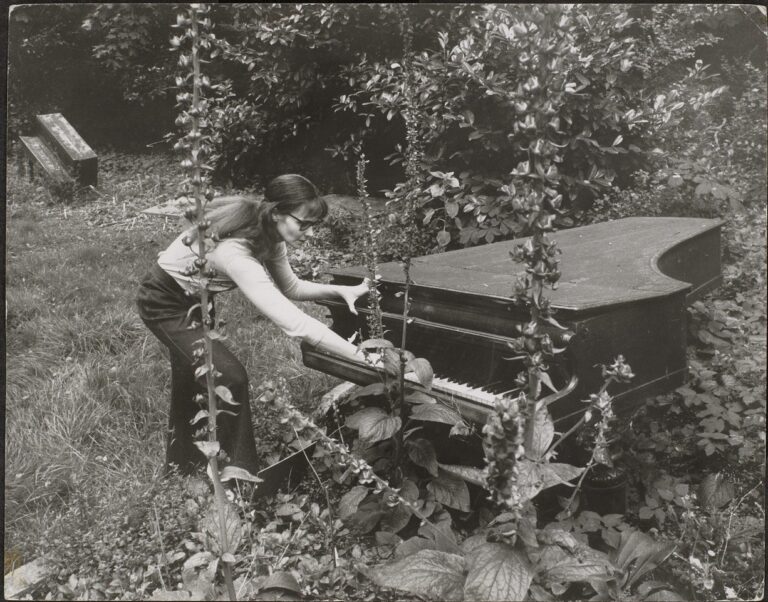
Since the 1980s, Monahan has created kinetic sound installations based on the principle of a piano placed outdoors with long stretched strings activated by the wind. In 1984 he presented his first internationally recognized work of this kind—Long Aeolian Piano in the landscape of New Brunswick—which today belongs to the canon of sound art.
The installation A Piano Listening to Itself originated in the early 2000s as a result of the artist’s long-term research in this field. In different versions it has been presented in Warsaw (Royal Castle), Brno (Villa Tugendhat), Mexico City, and elsewhere.
For the version presented in the úúú series within Trenčín 2026, Monahan decomposes piano works by Henry Cowell and Frédéric Chopin. For the Beckov installation he creates new compositions responding to the Slovak context by working with music by Johann Nepomuk Hummel (1778–1837)—a Bratislava-born piano virtuoso and composer.
Gordon Monahan (1956) creates works for piano, loudspeakers, video, kinetic sculpture, and computer sound environments that cross various genres—from avant-garde concert music to multimedia installations and sound art. As a composer and sound artist, he contrasts the quantitative and qualitative aspects of natural acoustic phenomena with elements of media technologies, natural environments, architecture, popular culture, and live performance.
Alongside sound installations and performances in the field of sound art, he also composes concert music for traditional instruments. John Cage once said of him:
“At the piano, Gordon Monahan produces sounds we have never heard before.”
úúú is a space for cultivating (not only) sonic sensitivity in the time of the sixth mass extinction.
It presents sound performances, interventions, installations, workshops, lectures, and discussions inviting us to listen to the Loud New World. It encourages quieting down, loving sonic nuances, and searching for new paths out of today’s crises.
We are interested in everything—from the rumble of a highway overpass, to a mole digging in the soil, to the echoes of abandoned factory halls, to the wind leaning against the castle rock in Trenčín.
The city and everyday life are where it all happens.
The úúú series is part of the project The Power of Sound, within Trenčín 2026.
Trenčín 2026 is financially supported by the City of Trenčín, the Trenčín Self-Governing Region, and the Ministry of Culture of the Slovak Republic.
The European Union is a partner.