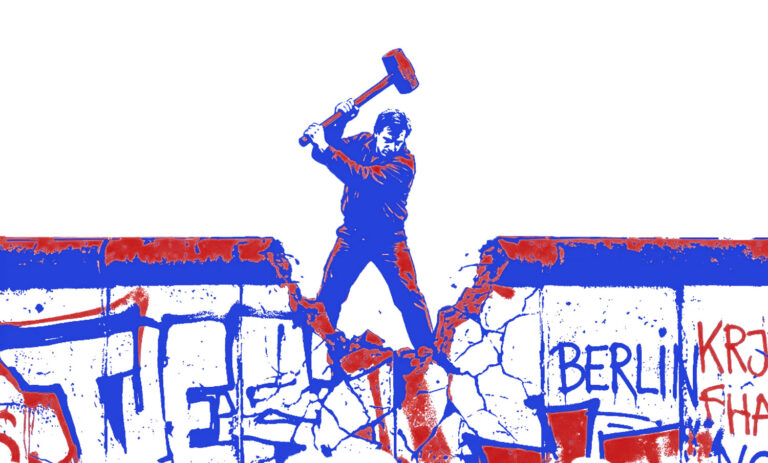
Sounds of Democracy: The Velvet
When: 14 November 2025
Where: Cultural and Creative Centre Hviezda, Trenčín
Admission: Free
How did freedom sound when it was born under our windows?
The project Sounds of Democracy, which we organize together with the Pohoda festival, will bring a series of events that explore how democracy and civic courage manifested themselves in different corners of Europe – from Slovak squares through Estonian songs to Polish punk.
On November 14, 2025, at KKC Hviezda in Trenčín, we will return to the events of November ’89 from a perspective outside the main centers of action.
Come experience an evening full of music, freedom, and important memories.
PROGRAM
17:00 – 22:00 – Workshop Samizdata ‘26
Samizdat refers to unofficial, secretly distributed texts – books, magazines, leaflets, or other written materials that were created outside state censorship, especially during communism in the countries of the Eastern Bloc. The authors of samizdats wrote freely, outside official structures, often under a pseudonym, aware that they were taking a risk. The project Samizdata ‘26 builds on this tradition – and at the same time turns it upside down. In a time when the “freest” expressions are spread anonymously and digitally, Samizdata ‘26 invites people to speak openly and under their own name.
In the foyer, a live sharing space will be created: an open recording booth where every visitor can record their personal statement, thought, poem, memory, or message to the future.
Each voice becomes part of a collective samizdat, which will be continuously transcribed into text form and, after the event, published as a digital edition Samizdata ‘26 vol. 1 – freely shareable and open for further additions.
17:00 – Discussion: A Gentle Revolution Beneath the Window: How Did November ‘89 Unfold in the Czechoslovak Regions?
In November ‘89, the headlines of world newspapers were filled with images from Prague’s Wenceslas Square and Bratislava’s SNP Square. Crowds, jingling keys, Václav Havel on the balcony. But freedom was also being born elsewhere – under the windows of our homes, in clubs, at schools, in small towns, and on squares that world cameras never captured. The discussion will look at November ‘89 from a perspective outside the main centers of events – at how the revolution unfolded in two smaller Czechoslovak towns, Trenčín and České Budějovice – which represent places that may not have appeared in newspapers but without which change would never have happened.
We live in great history, but we’re not buried in it up to our necks, wrote dissident and philosopher Milan Šimečka. Come see for yourself that even the small histories – personal, local, quiet – are often what can move a country.
The discussion will be moderated by Michal Havran.
The guests will be:
Rudolf Dobiáš – Slovak writer and political prisoner of the communist regime, who as a young man experienced direct confrontation with repression;
Zora Bútorová – sociologist and co-founder of the Institute for Public Affairs, who has long focused on democracy, civil society, and the development of public opinion in Slovakia after 1989;
Branislav Jobus – musician and author, who will also perform during the evening – he will bring to the discussion the perspective of art, subculture, and their ability to weaken authoritarian power structures; and
Josef Halla – from the Nation’s Memory Institute (ÚPN), a witness of November 1989, who will add the Czech context and parallels to the conversation and bring period photographs and materials that will enrich the visual setting.
18:00 – Concert Karpatské chrbáty
The band was formed in 1982 under the name VEGET, which was banned in times of non-freedom and changed in 1986 to Karpatské chrbáty, which meant: Karpatské, a type of alcoholic drink, and Chrbáty, jump on our backs. The band is popular for its humorous and absurd performances, embodied mainly by its co-founder and frontman Braňo Jobus.
19:00 – Screening: The Singing Revolution (2017, documentary, USA / Estonia)
Trenčín 2026 x Tartu 2024
Can music change the course of history? In 1991, after almost fifty years of brutal Soviet occupation, the small Republic of Estonia declared independence from the Soviet Union. This event foreshadowed the collapse of the USSR and the rapid liberation of all Soviet republics. In this historic moment, music played a key role. The film The Singing Revolution tells the story of the enormous desire of Estonians for self-determination and their unwavering belief in restoring their country’s independence.
The Singing Revolution: https://youtu.be/4njksFKyycY
21:00 – Hańba! (PL)
The Polish group Hańba! originally arose as a fictional street band in the working-class suburbs of Krakow in the 1930s and 1940s. According to them, punk was born there and in those frenetic times – not some forty years later, as music textbooks say. The result is an exciting, rebellious sound that springs from the rich culture of a hectic era. Electric guitars were replaced by banjo and accordion, and the bass guitar by a pulsating tuba.
This concept still works for them today, although, as they themselves say, it is now difficult to distinguish fiction, poetry, and historical costumes from the sad and ugly face of the present. And so they continue to play and sing about corruption, the suppression of democratic values, and social inequalities.
The band has played on stages and festivals in the United States, Canada, Australia, and all over Europe – in Trenčín, they last appeared at this year’s Pohoda.