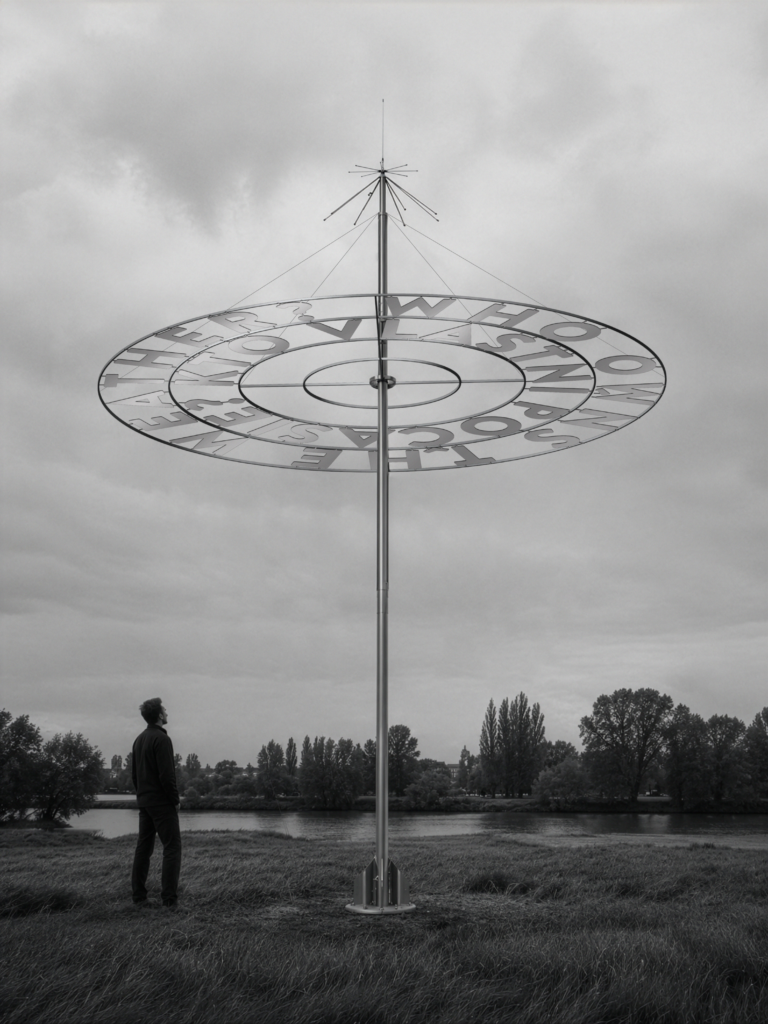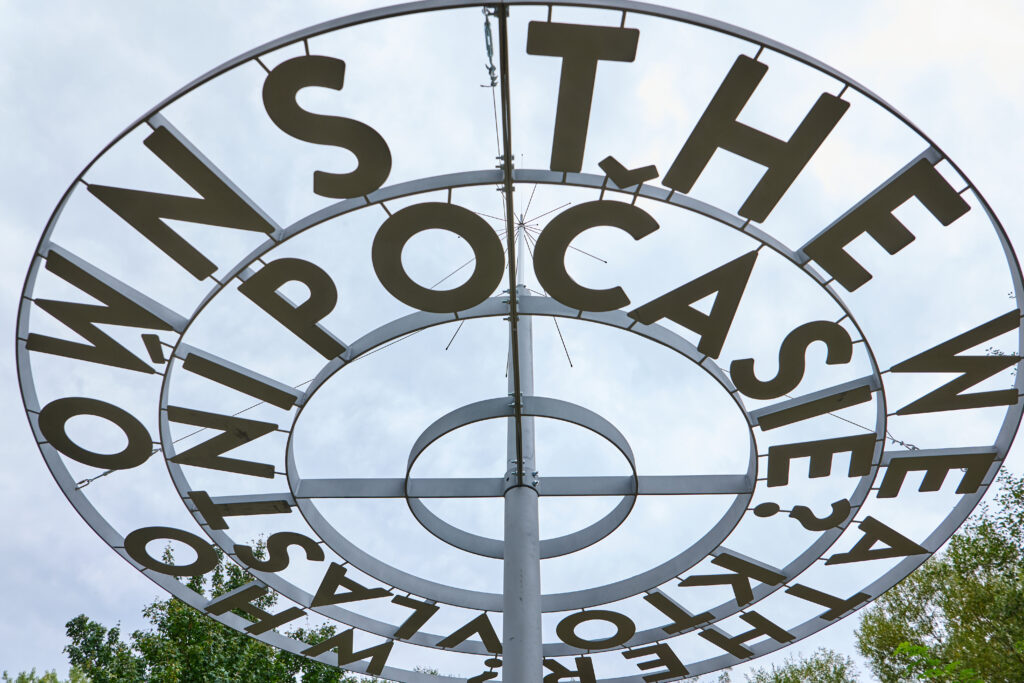
The work of the Romanian artist duo is a large steel structure resembling a meteorological antenna — almost like a scientific instrument, but above all a sculptural work in the form of an unanswered question. In its circular metal part, it has the inscription “Kto vlastní počasie?/Who Owns the Weather?” cut-out. This phrase is partially legible on the object but becomes fully visible as a shadow cast on the ground when sunlight passes through the carved letters. The readability of the text depends on the position of the sun, the time of day, the season and atmospheric conditions.
Location: Váh Riverbank, Trenčín
The work functions as an environmental tool, combining the radicality and a certain mystery of the question with natural variables. The project was inspired by the speculative report “Owning the Weather in 2025” prepared by the United States Air Force in 1996, which examined the potential of weather modification technologies for strategic military purposes. While weather modification in a military conflict remained more of a utopia, in the context of the climate crisis, geoengineering technologies (weather modification for local mitigation of the climate crisis) have become a real topic of discussion, but a controversial one and criticized by the scientific community.
The question in the circle is intentionally left open. It is up to the viewer to think and answer for themselves. Does it point to climate change? Changes in weather patterns are happening today as a result of human activity — but not shared with the same degree of responsibility. Does it turn the spotlight on fossil fuel corporations, wealthy states, and business and political lobbyists who are disproportionately exacerbating the crisis while avoiding responsibility? Or should we take a critical look at the military industry and the states that have already experimented with, or considered, manipulating local climate conditions for strategic purposes?
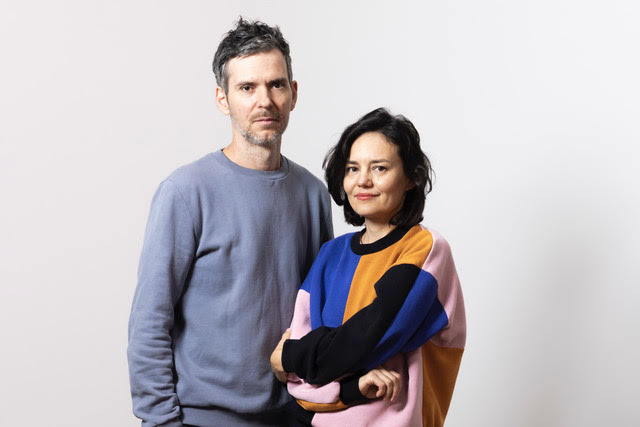
Anca Benera and Arnold Estefán have worked together as an artist duo since 2012 and are currently based in Vienna. Their practice spans multimedia installation, sculpture, and drawing, exploring the intersections of history, environment, and resource politics. Recent works investigate how military imaginaries shape landscapes, climates, and communities, examining the ways past conflicts continue to influence the environments we inhabit and the futures we imagine. They are representing Romania at the 61st La Biennale di Venezia in 2026 with the solo presentation Black Seas – Scores for the Sonic Eye. Their work has been exhibited internationally at museums and biennials including Manifesta 15, Barcelona (2024); Kyiv Biennial (2015, 2023, 2025); Klima Biennale Wien (2024); Neuer Berliner Kunstverein, Berlin (2023, solo); MUMOK, Vienna (2017); the 13th Istanbul Biennial (2013); and La Triennale, Palais de Tokyo, Paris (2012). They are recipients of the Birgit Jürgenssen Prize (2022) and Creative Fellows at UCL’s Centre for Postsocialist Art, London (2023).