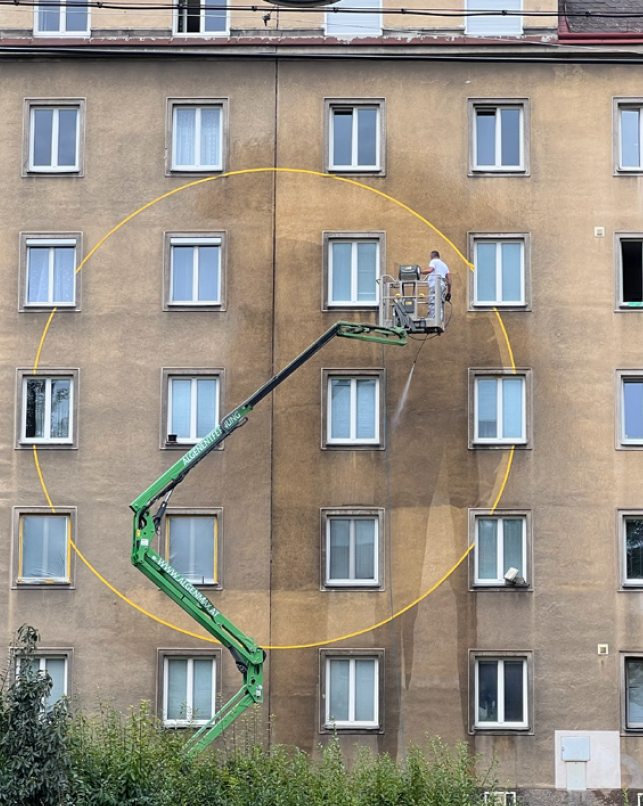
WeisserFleck (white spot) is an intervention in public space that creates a new attractor—an ephemeral graphic on a building façade—while communicating themes of biopatina, urban ecology, and air quality. WeisserFleck is an outcome of the project City Sensitivity, which responds to approaches that consider architecture as the creation of environments not only for human actors. Spaces and objects function as envelopes for diverse biotopes—from plants and microorganisms to insects and small animals—while also creating high-quality public spaces.
The WeisserFleck intervention is deliberately situated on post-war architecture with cement plaster. These buildings were originally designed as rational, durable, and visually controlled structures, with surfaces intended to appear clean, homogeneous, and timeless. Cement plaster ensured stability and resistance, but at the same time created ideal conditions for the formation of biopatina—microbial and mineral layers that today function as an active ecological interface between the building and its environment. Current maintenance practices often involve covering façades with EPS polystyrene insulation, which completely conceals the original surface. This not only erases the material and historical trace of the building but also removes the existing surface ecosystem that has developed on the cement plaster over decades. Architecture thus shifts from an active, responsive body to a closed object.
WeisserFleck responds to this tendency in a sensitive and selective way. Instead of covering the surface, it works with a minimal, precisely defined intervention that highlights the contrast between the “cleaned” area and its surroundings. This contrast draws attention to the qualities of biopatina as an ecological system—its ability to bind pollutants, regulate moisture, and record environmental conditions. The white circle is therefore not a repair, but a tool for reading the surface.
This site-specific project is realized by the international platform Dusts Institute (based in Vienna, exhibited at the 2025 Venice Architecture Biennale). The accompanying programme includes guided tours, workshops, and community activities.
When: August 27, 2026 at 17:00
Where: Nová Dubnica