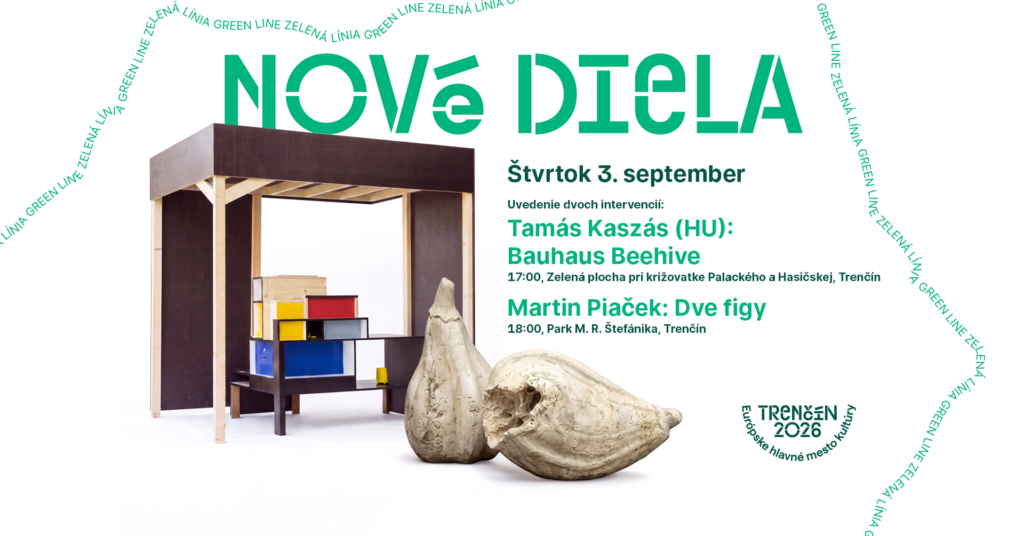
When? 3 September 2026, from 5:00 PM
Where? Green space at the intersection of Palackého and Hasičská Streets / M. R. Štefánik Park, Trenčín
Both works were created as part of the Green Line project, which brings works by international and Slovak artists addressing environmental issues – the climate crisis, biodiversity loss, and the relationship between humans and nature – into Trenčín’s public spaces. The project is curated by Oto Hudec.
Programme
5:00 PM – Tamás Kaszás (HU): Bauhaus Beehive – green space at the intersection of Palackého and Hasičská Streets
6:00 PM – Martin Piaček (SK): Two Figs – M. R. Štefánik Park
Bauhaus Beehive
This experimental and educational beehive is based on the traditional Dadant-Blatt standard for frame dimensions, making it compatible with conventional hives. At the same time, it features horizontally offset hive boxes, allowing it to function as a system for two bee colonies. A swarm will be introduced into the hive under the supervision of a professional beekeeper. The hive will serve not only an aesthetic purpose, but also experimental, observational, and productive purposes, including honey production. Due to its complex structure, working with the hive requires a slow and careful approach.
About the Artist – Tamás Kaszás
Born in 1976 in Dunaújváros, Hungary, Tamás Kaszás is an artist and educator based in Budapest. He graduated from the Intermedia Department of the Hungarian University of Fine Arts, where he currently teaches. His practice focuses on complex projects grounded in theoretical research and incorporates both traditional and new media.
By combining poetic imagery with functional objects, Kaszás creates installations that he describes as “visual aid constructions”, in which individual artworks function like constellations within a broader whole.
His projects explore social and ecological issues, spiritual practices, and alternative ways of living. Key concepts such as collapse and survival, self-sufficiency and autonomy, theory versus practice, folk science, fictional anthropology, and living in nature outline his main areas of interest.
He is a founding member of two artistic duos: Randomroutines (with Krisztián Kristóf, since 2003) and Ex-artists’ Collective (with Anikó Loránt, 2003–2020).
His solo exhibitions have been held at venues including the Hungarian National Gallery, Budapest (2023); Trafó House of Contemporary Arts, Budapest (2021); de Appel, Amsterdam (2018); Museu Calouste Gulbenkian, Lisbon (2017); Muzeum Sztuki, Łódź (2016); and Galerie Krinzinger, Vienna (2014).
His work has also been featured in major group exhibitions and international events, including Werkleitz Gesellschaft, Halle (2025); EVA International, Limerick (2023); documenta fifteen, Kassel (2022); OFF-Biennale Budapest (2017); Bucharest Biennale 7 (2016); the 19th Biennale of Sydney (2014); and the 12th Istanbul Biennial (2011).
Two Figs
Two sculptural objects depicting carved figs – dramatically oversized, as though they had accidentally fallen or been forgotten beneath the pine trees in the park near the railway station – emerge from Martin Piaček’s long-standing interest in the fig fruit and tree.
The fig is not native to Slovakia, but as the climate gradually warms, it is becoming increasingly common, particularly in the south of the country. Piaček, a sculptor and educator, has an orchard in Rajka where he grows figs himself. His relationship with the subject is therefore rooted equally in personal fascination, practical experience, and environmental concern.
Carved from Slovak travertine, the objects will respond to their surroundings and enter into dialogue with the existing sculptures in the park. Their placement beneath pine trees is deliberate: it heightens the contrast between climatic zones and draws attention to a climate that is inevitably changing.
Yet the change symbolised by the fig is not merely a story of new possibilities for growing exotic fruit in Central European gardens. It is also a story of increasingly unstable weather and the social upheaval brought about by climate change. The presence of the stone figs on the lawn thus embodies a paradox: fascination with the beauty of a fruit becoming commonplace due to a shifting climate, alongside unease about where that shift may lead.
About the Artist – Martin Piaček
Photo credit: Peter Frolo
Martin Piaček (1972) is one of the prominent figures in contemporary Slovak sculpture. Although his practice also extends into other areas of visual art, including performance and video/photo documentation, sculpture has remained his primary means of expression.
One of the defining principles of Piaček’s work is the connection between personal experience and collective memory. His works address questions of national identity, historical memory, nationalism, and patriarchal models of behaviour. He often works with figures of national heroes, such as Milan Rastislav Štefánik and Ľudovít Štúr, as well as iconography and symbols associated with official history, placing them in new contexts and opening them up to new interpretations.
Research and the detailed study of history also play an important role in his practice. Rather than treating history as a closed narrative, he approaches it as open material that can be reconsidered and challenged, as in his ongoing series The Greatest Embarrassments of Slovak History. Another characteristic element of Piaček’s work is his use of appropriated objects, particularly existing historical artefacts, as seen in the series Touching the Hero and Self-Portrait as a Bust of M. R. Š.
The currently presented work from the Marble series confirms sculpture as the medium to which Piaček repeatedly returns. Despite the availability of modern technologies, he chooses the slow, manual process of carving into a block of marble. In an age of rapid production, slow work can appear to be a form of luxury. The artist’s physical effort therefore remains present in the work as an important trace, rooted in the direct contact between the sculptor’s body and the material.
Piaček’s sculptural process reflects a broader perspective on humanity’s relationship with labour and raises questions about work as a foundation of social order. The resulting form becomes a fragment of the artist’s sustained labour recorded in stone.
Martin Piaček’s practice represents an ongoing effort to critically examine what sculpture means today, who public space belongs to, and how collective identity is constructed within it. He studied at the Academy of Fine Arts and Design in Bratislava (VŠVU) in the studios of Juraj Bartusz and Jozef Jankovič, later joining the institution as an educator. Since 2017, he has led the vvv Studio (visual – verbal – public) at VŠVU.
Alongside his artistic practice, he actively contributes to discussions about the nature and role of contemporary sculpture in public space through the Verejný podstavec civic initiative. He participates in the Liquid Dogmas project and is preparing the Soft Norm lecture series. He is also one of the founders of the DiStO (Theatre of the Static Object) exhibition format. Piaček’s works are regularly presented in solo and group exhibitions in Slovakia and internationally.
Simona Pallesichová
Green Line Artworks
Oliver Ressler (AT): Out of the Underpass to Take Back the Sky – Hasičská underpass
https://www.trencin2026.eu/podujatie/otvorenie-intervencie-olivera-resslera-at/
Rigo 23 (US/PT): The River Is Sacred for Its Own Sake – mural, Low-Threshold Centre
https://www.trencin2026.eu/podujatie/mural-rigo-23/
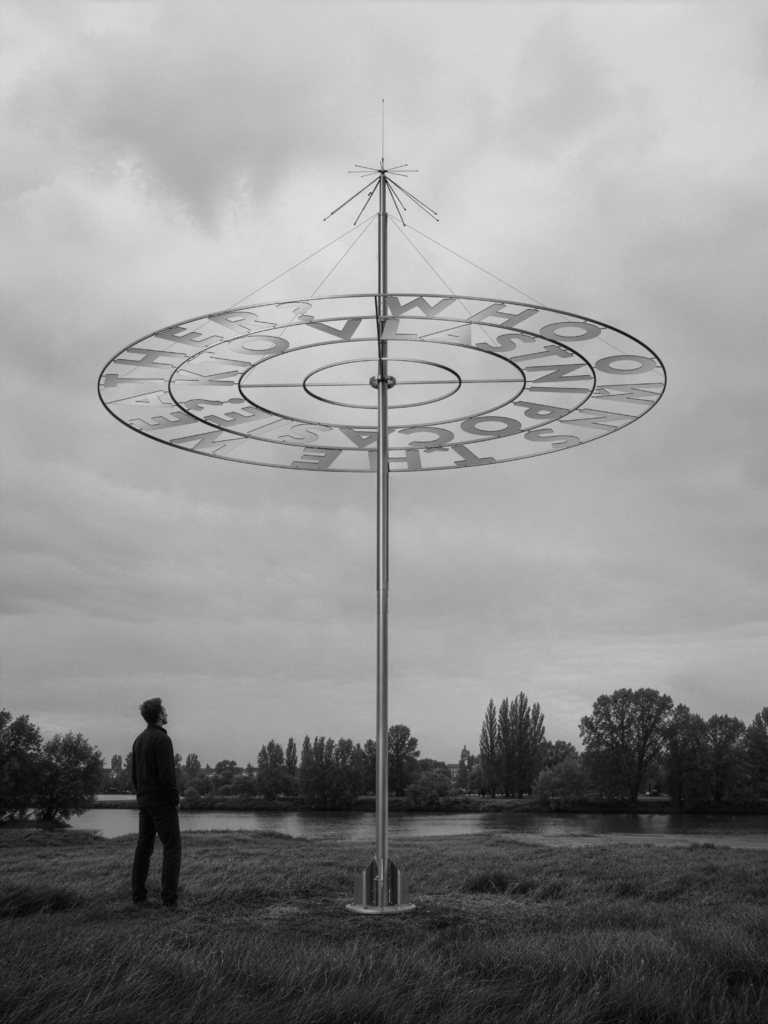
Anca Benera & Arnold Estefán (RO/AT): Who Owns the Weather? – Váh riverfront
https://www.trencin2026.eu/podujatie/kto-vlastni-pocasie/
Tamás Kaszás (HU): Bauhaus Beehive – green space at the intersection of Palackého and Hasičská Streets
Martin Piaček (SK): Two Figs – M. R. Štefánik Park
The Thin Green Line exhibition – County House (Župný dom), 11 September–6 December 2026
https://www.trencin2026.eu/podujatie/vernisaz-vystavy-tenka-zelena-linia/
Green Line Bike Ride – 13 September 2026
https://www.trencin2026.eu/podujatie/cyklojazda-po-umeleckych-intervenciach/