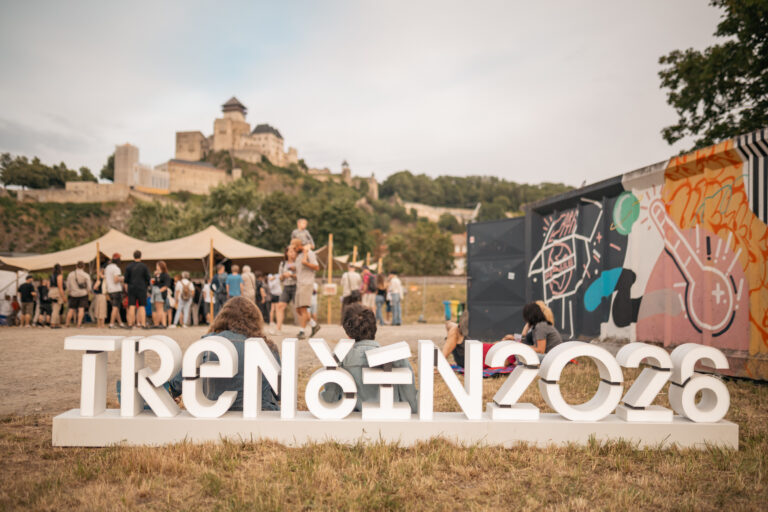
Ukrainian writer, essayist, and literary critic Roksolana Zharkova is currently a resident of the TrenAir program in Trenčín, which is part of the European Capital of Culture Trenčín 2026 project. During her stay, she met with Ukrainian women who found a temporary home in Trenčín after fleeing the war.
The result of these encounters is a powerful literary-reportage text in which the author captures their everyday lives, losses, fears, but also mutual solidarity and hope. Written during the pre-Christmas period, the text offers an authentic testimony about the lives of women whose reality differs dramatically from the city’s festive atmosphere.
Article:
“I Want to Go Home So Much”:
Pre-Christmas Conversations in Trenčín with Ukrainian Women Who Fled the War
All cities are the same before Christmas: bright garlands sparkle, the air is filled with the scent of fir branches and hot Christmas punch, hundreds of people wander through Christmas markets, amazed by colorful, variously shaped gingerbread cookies; shiny ornaments delight the eye, and snow-covered smiling angels warm our hearts.
All cities are the same before Christmas. No, not all of them. Our Ukrainian cities, under enemy missiles and drones, experience daily destruction and tragedy. The war continues. And nothing can stop it — not even the approaching Christmas and the birth of the Son of God.
I came here to write about the city. About the way of life of this city. About the people of this city. In a few days, Trenčín will become the European Capital of Culture 2026. Trenčín with all its local peculiarities: the town hall and Trenčín Castle, churches and monasteries, the Evangelical church and the Jewish synagogue. And with its square of peace — the famous Peace Square.
Trenčín with all its residents, among whom, after February 2022, many Ukrainians have appeared — men and women who found a temporary second home here.
Women Helping Women
Olga (originally from the Kyiv region) has been living in Trenčín for more than ten years. She coordinates a community of Ukrainian women and organizes various intensive educational courses and training sessions focused on personal and professional development.
Natalia from Kharkiv, who has lived in Trenčín for almost four years, provides counseling on the Slovak language and the specifics of the education and healthcare systems, and willingly shares her experience with newcomers.
Everyone is brought together by the wonderful Ms. Danka, the head of the project “Trenčín Helps Ukraine”, who takes care of language courses for displaced people, the collection of humanitarian aid, and various charitable and awareness-raising activities. Ms. Danka was born in the Slovak border region — almost equally close to Poland and Ukraine. She tries to help everyone — in any way she can.
“And What Would I Do in Their Place?”
I met Ms. Danka in one of the cozy cafés on Peace Square. We drink coffee and tea and talk a lot about Ukraine, about political and cultural events in our countries, about the Russian-Ukrainian war.
“When did you feel the need to do something for others, for us Ukrainians?” I ask her. She explains:
“When it all started, we simply couldn’t stay aside and sit with our arms folded. A friend said: let’s take things there. We took them, and then we visited those centers again. They were distributing aid, food, and clothing. I saw those people from Ukraine, and my heart felt heavy. I came home and thought: What would I do in such a situation? What would I do in their place? Deciding to leave everything behind and go away from your home is very hard…”
“Put Your Crown in the Nightstand Drawer…”
“It’s hard for us because back home we had a certain status, our place, our space. And when we came to a foreign country, we had nothing of our own. As my husband used to say: Put your crown in the nightstand drawer and go clean. And that’s exactly what I did…” recalls Valentyna from Kherson.
“Now I rent an apartment together with friends. The rent is expensive. But before, it was even harder — we had to share a room in a hotel or dormitory with people we barely knew and cook in a shared kitchenette. There were misunderstandings, arguments, people almost fought over cutlery or space on the stove,” says Tania from Donetsk.
“I Couldn’t Get Used to This Word for a Long Time”
“I came from the Kharkiv region, from a small Russified town. Here in Trenčín, I started learning not only Slovak but also Ukrainian all over again. I worked in a warehouse — it was physically and psychologically hard. Back home, I worked in culture for twenty years: I created, played the guitar, wrote songs, prepared scripts. Here, I’m saved only by volunteer creative work. I sing and perform for donations, just to help Ukraine at least somehow. I feel that I will never be at home here. I want to go home so much — to my pre-war life,” Olena states sadly.
“I’ve noticed that we’re forgetting Ukrainian, even though we haven’t yet learned Slovak,” admits Tetiana from Khmelnytskyi. Her parents stayed in Ukraine, her brother is fighting at the front, and her daughters went to Bratislava. They study remotely and work in cafés. It’s enough to survive, but they miss home terribly.
“Displaced persons… I couldn’t get used to this word for a long time,” Tetiana adds.
“We Are Afraid for the Lives of Our Children”
“If we didn’t have children, if we weren’t mothers, we wouldn’t have left anywhere. We’re afraid for our children’s lives. At first, I also thought it would be for a short time — a week or two, a month or two — and we’d go home. But no. I think we’ll never learn Slovak as well as Ukrainian. Many of us started working immediately to provide for our children, so we don’t have time to learn the language. We went to factories or to wash dishes. If it weren’t for the children, we would…” explains Liudmyla from Sumy, with tears in her eyes.
Julia (who first fled from Crimea and later from Kherson) arrived with two daughters, one of whom has cerebral palsy. The child’s disability is confirmed by Ukrainian documents, which, however, have no legal validity within the EU.
Julia is a speech therapist and works with Slovak and Ukrainian children with autism and speech disorders. Yet as a caring mother, she cannot protect the rights of her child with a disability.
“It’s sad because we can’t even apply for a designated parking space,” she notes.
“I Slept Little, Worked a Lot, and Compensated Stress with Food”
Kateryna is forty years old, a psychologist who studied in Kharkiv and had her diploma recognized in Slovakia. She now works as a waitress in one of the city’s cafés. It feels as if only yesterday she successfully finished university, was writing her doctoral dissertation, and dreaming of a peaceful family life.
In March 2022, she arrived with her teenage daughter — first in Pezinok, then Bratislava, and finally Trenčín. She worked in a factory for ten months, but the exhausting schedule worsened her health. One day she learned about the project “League for Mental Health,” contacted the organizers, and unexpectedly received an offer to join the community.
Kateryna provided psychological counseling and, together with colleagues, organized art-therapy meetings, excursions, and clubs. A separate part of her work involved cooperation with women trying to process war trauma, as well as women who had experienced or were experiencing gender-based violence, discrimination, pressure, or persecution. Unfortunately, the project ended, and Kateryna was again left without a job. Later, she found work in a café.
“Sometimes it’s all very exhausting. I don’t expect anything from anyone; I just try to cope with life. I want my daughter to feel happy and have everything she needs. Right now, she wants Adidas sneakers as a Christmas gift…”
“And What I Carry in My Heart…”
“There we were under occupation, sitting in basements. Here we have peace, food, clothing — but we don’t feel at home, and our loved ones aren’t nearby. No, everything is fine. It’s the Christmas season now. We’ll rejoice, smile, and what I carry in my heart will be known by my family, my friend… or no one,” Iryna lowers her gaze.
While talking with Ukrainian women, I realized that not all of them are ready to speak openly about their experiences, their stories of adaptation and socialization — sometimes not even under their own names. For some, it is painful to pronounce the names of the places they came from. It is the traumatic experience of fleeing the war — sometimes also fleeing from themselves.
A Little Hope and Faith in Good Changes
During Slovak conversation courses, we talk about topics far removed from anything festive: the ongoing war, politicians on whom our future depends, mothers and children, elderly parents in Ukraine, men fighting at the front.
Ms. Danka hosts us with hot tea and delicious cookies, trying to comfort and encourage us, and to bring a bit of hope into our conversations — faith in light at the end of the tunnel and in positive changes in the new year.
“Before Christmas, a puppet theatre from Uzhhorod will come to visit us for the weekend. It will be interesting for children and adults alike. Come,” Ms. Danka adds.
I thank her and say goodbye to everyone. After these conversations, after these confessions of Ukrainian women, my soul is filled with many questions — and answers.
I leave the KKC Hviezda, climb the stairs to the yellow bridge on Bratislavská Street, and look at the sky dotted with tiny stars. Beneath the noise of cars and buses, the Váh River falls asleep below, quietly flowing into its December, still snowless dreams. A few weeks before Christmas.
Roksolana Zharkova (UA)
This article was written during a residency within the TrenAIR-2026 program.