
Three world-renowned works in Trenčín reveal pivotal shifts in 20th-century music
From 25 to 27 September, Trenčín will host three radically different approaches to the piano – and, in fact, three entirely different manifestations of the instrument we know by that single name. As part of its acoustic series úúú and pssst, the ooo association will present artists who not only understand and use the piano differently, but literally transform it. Through three world-renowned works, artists from New Zealand, the United States and the Czech Republic will bring to Trenčín not only their instruments, but also stories about why it became necessary to abandon the piano, transform it, or build it entirely anew.
The events introduce pioneering artists who were unafraid to intervene in that symbol of music: the piano. Its elegance, majesty, solemnity and certain untouchability had already become an invitation to experiment for many artists at the beginning of the last century. And so they began to alter it, turn it inside out, venture into its interior, and open it up to both the ears and the eyes.
“Of the many bold approaches to the piano, we selected three that mark major turning points in music across the entire century, right up to the present day, when we are ceasing to regard the piano as untouchable and can instead understand it as something far more accessible,” says Fero Király, curator of the events.
Behind each of these turning points lies a personal story as well: an artist’s need to step outside the traditional idea of the piano and the pianist and explore what can happen when we stop taking the instrument for granted.
Playing notes we could not play before
Czech composer Alois Hába wanted to hear notes that conventional instruments could not produce. And so he commissioned an instrument of his own – a sixth-tone harmonium – a unique instrument whose construction in the early 20th century was financed through a public collection to which President Masaryk also contributed.
Only three examples survive worldwide today. The only playable one is being loaned to ooo by the National Museum in Prague and will be brought to Slovakia for the first time in history – to Trenčín.
Its story, however, is not only about music.
“It is also a story about what we, as a society, are willing to support and what value we are capable of assigning to bold and radical experiments. The Czech Republic is currently building a new sixth-tone instrument, despite the fact that only one person in the world knows how to play this instrument – Miroslav Beinhauer. He will show us that even something once considered too radical can, over time, transcend the boundaries of experiment and become part of our cultural memory,” Király adds.
At the concert, Beinhauer will perform a work by legendary American minimalist Phill Niblock, composed specifically for this instrument, as well as Alois Hába’s Adagio Op. 37. In Trenčín, the past will thus meet the future – perhaps also revealing how much of our own cultural history we are unable, or unwilling, to hear today.
Hearing the piano from within
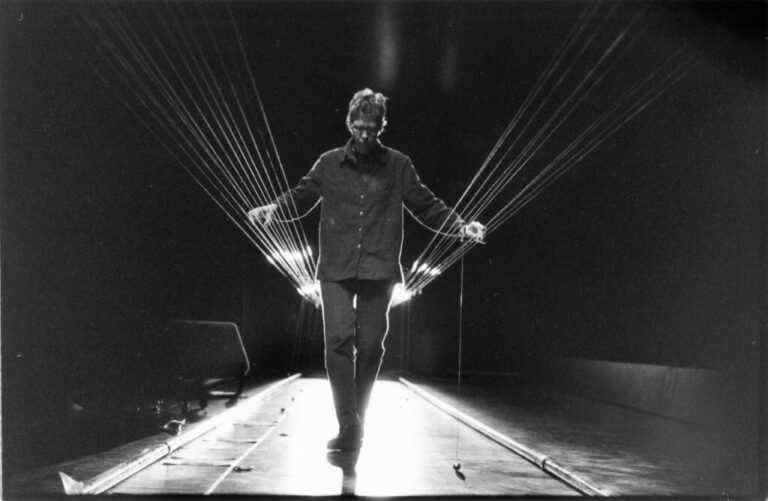
People describe the Long String Instrument as sounding as though you were hearing a piano from the inside. Ellen Fullman reduces the piano to its most essential element – its strings. But are strings alone enough to make a piano? The answer is up to the listener, just like one of the fundamental questions of contemporary music: where does music begin?
Imagine sitting in a room surrounded by differently tuned strings stretching for dozens of metres. A performer walks among them, playing them with her fingers, while their sound surrounds you.
The American artist had this instrument installed in her studio for many years, and with it earned a place in the encyclopaedias of 20th-century music. Only many years later did she adapt it into a portable version with which she now travels – including to Europe and directly to Trenčín, where it will be installed at FOR MAAT Gallery.
The instrument, which can measure between 16 and 30 metres in length, has to be built anew at every location; constructing and tuning it takes three to five days. In Trenčín, Ellen Fullman will perform two concerts – on 25 September at 7:00 p.m. and 26 September at 5:00 p.m.
A piano absorbed by the landscape
As the final event – and a farewell after two years during which we have sought to reveal music in different shades and nuances – comes the renowned New Zealand sound artist Annea Lockwood, with a piano that no longer needs either a musician or a concert hall.
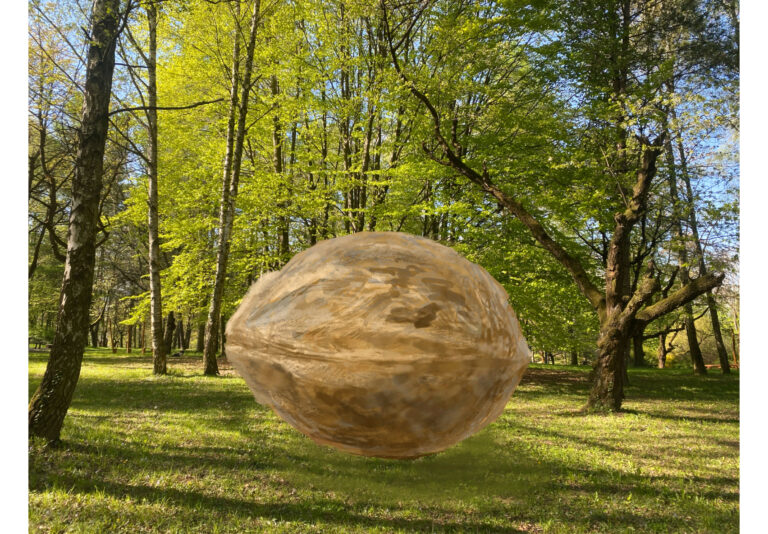
In her 1969–1970 work Piano Garden, she leaves an old upright piano half-buried in the ground and allows plants to grow over it, entrusting its future to nature.
The instructions for realising Piano Garden read:
Dig a sloping trench and slide the piano into it so that it is half-buried in the ground. Plant fast-growing trees and climbing plants beneath and around the piano. Do not protect it from the weather. Leave it there forever.
The musical instrument thus becomes a living place, and the concert becomes a process that can last for years or even decades.
Piano Garden has found just such a setting at ŽiTo V SÝPKE in Moravské Lieskové – a place where gardens, freedom and time all have a natural home. In September 2026, the world’s sixth currently ongoing Piano Garden will be created here, with its opening taking place on 27 September at 3:00 p.m. Apart from Moravské Lieskové, the installation can currently be seen only in the United States, Australia, Wales, Germany and Portugal.
“This, too, is what a piano can look like today: it can be reduced to strings, given notes it never had before, or allowed to be absorbed by the landscape. Not as a gesture of disappearance, but as a question of what happens when we relinquish the need to control everything. Perhaps it is precisely there, on the boundary between desire and uncertainty, that music begins – music that may endure longer than we do. This is what we have tried to show over these two years of encounters with and around music, and with people who perceive it as something more than human,” say Fero Király and Eva Vozárová, curators and driving forces behind the ooo association.
Programme
Friday, 25 September, 7:30 p.m., Galéria Formaat
Saturday, 26 September, 5:00 p.m., Galéria Formaat
Ellen Fullman: The Long String Instrument
Saturday, 26 September, 7:00 p.m., KKC Hviezda
Miroslav Beinhauer: sixth-tone harmonium
Alois Hába: III. Adagio, Op. 37 for sixth-tone harmonium (1928) – 4 min
Phill Niblock: Harmonius for sixth-tone harmonium (2022) – 60 min
Sunday, 27 September, 3:00 p.m., ŽiTo V SÝPKE
Annea Lockwood: Piano Garden
Admission to all events is free.
Admission to the pssst: Piano events requires registration.
Ellen Fullman:
https://tootoot.fm/en/events/6a554c8d4e5f28ebcf25f379
Miroslav Beinhauer:
https://tootoot.fm/en/events/6a554f9e4e5f28ebcf29255b
Annea Lockwood:
https://tootoot.fm/en/events/6a55522c4e5f28ebcf2b71fd
Web:
https://pssst.zdruzenie.ooo
https://uuu.zdruzenie.ooo
The sixth-tone harmonium (inv. no. E 2527) comes from the collections of the National Museum – Czech Museum of Music.