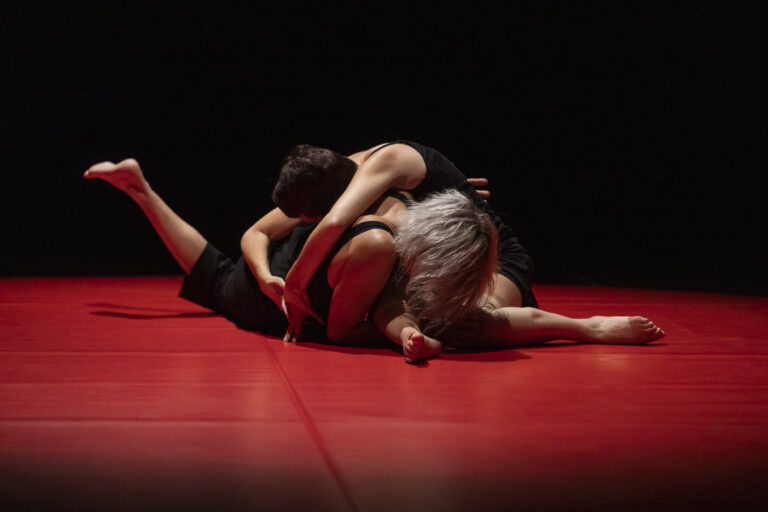
Ballroom dance has long been considered a cultivated form of social interaction. It creates space for eye contact, the touch of hands, closeness, shared steps, and gestures. Beyond its energy and structure, it also reflects a stereotypical view of the male–female pair, with its hierarchical. An unusual combination of brass band music and dance performance. A live brass band concert unfolds alongside a dance performance — two independent elements sharing the same time and space. The dancers move directly among the audience, transforming the Courtyard beneath the Town Tower into a vibrant space filled with music and movement from every direction.
Social dance has long been regarded as a refined form of social gathering. It creates space for eye contact, holding hands, closeness, moving in step, and shared gestures. Alongside its energy and structure, it also reflects traditional ideas of male–female partnerships, with hierarchical roles embedded in the rules of competitive dance. When the couple separates, the nature of the dance changes — it becomes about individuality, tension, memory, discipline, or training. How many meanings can a dancing body carry? Brass band music is equally ambivalent by nature: joyful and energetic on one hand, nostalgic and poignant on the other.
The dance performance Dychotéka is co-created through the interplay of social dance and brass band music.
Concept and Artistic Direction: Silvia Buranovská (Sviteková)
Performance / Co-creation: Katarína Čillíková, Dominik Dolník, Julia Pabst, Matúš Szeghö, Lukáš Zahy, Lukáš Bobalik
Text: Slavo Sochor
Graphic Design: Matúš Szeghö
Expert Consultation: Anton Čierny, Juraj Korec
Photography: Veronika Vozárová, Marek Jančúch
Costume Collaboration: Dorota Volfová
Premiere: April 2025
(inspírium) is an original performative project by Silvia Buranovská (Sviteková) that continues the thematic line of her previous individual and collective works, characterised by a distinctive degree of absurdity and ambiguity that consistently frames her artistic practice. In this work, she explores the relevance of boundaries and tensions between high and low art, the urban and the rural, the isolated and the open, the conservative and the progressive. She fundamentally disrupts the conventions of the gallery space by introducing an almost physiological tempo-rhythm based on active breathing—or, if you prefer, on lighter genres. Buranovská (Sviteková) also naturally creates space for live interaction with the audience, although the work itself does not depend on that interaction. A brass band has never been this political.
(exspírium)
Slavo Sochor
About Dychovka Lieskované
We come from the village of Moravské Lieskové, situated at the foot of Veľká Javorina mountain. Brass band music has a long tradition in our village. Since our formation in 1989, we have been committed to continuing and developing this tradition. Our first public performance took place in the spring of 1990 in the village of Modrová.
Today, we have many years of performing behind us, with numerous appearances both in Slovakia and abroad. The welcoming atmosphere, the connection with our audiences, and their applause are experiences that continue to inspire us.
Our repertoire consists primarily of Slovak folk songs, complemented by original compositions with both lyrics and music, well-known international melodies, and instrumental pieces. Members of the band also contribute as composers of the original songs.