When? September 3, 2026 at 6:00 p.m.
Where? M. R. Štefánik Park, Trenčín
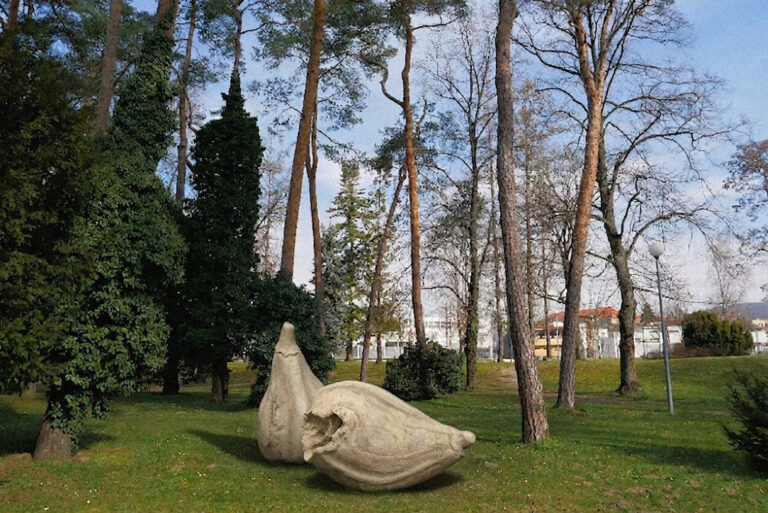
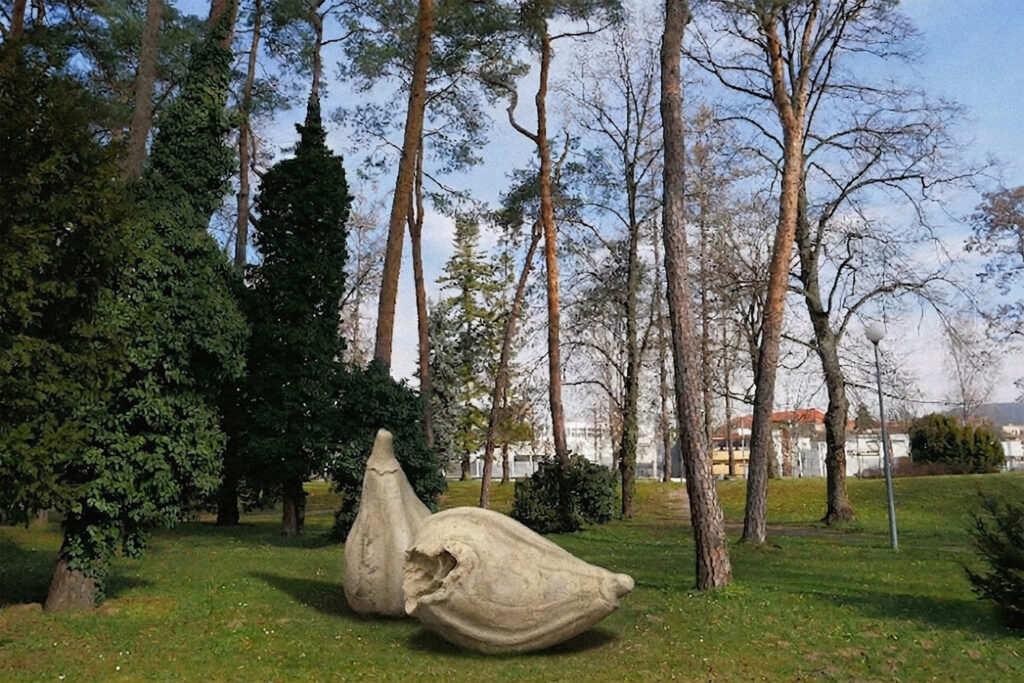
Two sculptural objects of carved figs—strikingly oversized, as if randomly fallen or forgotten beneath the pine trees in the park near the railway station—stem from Martin Piaček’s long-standing interest in the fig fruit and tree. The fig is a plant that did not originally grow in Slovakia; however, with gradual warming, it is becoming increasingly common, especially in the southern parts of the country. Sculptor and educator Piaček maintains an orchard in Rajka where he grows figs himself—his relationship to this subject is thus rooted in personal fascination, utility, and environmental concern.
Carved from Slovak travertine, the objects will respond to their surroundings and enter into dialogue with existing sculptural works in the park. Their placement beneath pine trees is intentional—it amplifies the contrast between climate zones and points to a climate that is inevitably changing. The transformation symbolised by the fig is not only a story of new possibilities for cultivating exotic fruits in a Central European garden. It is also a story of increasingly unstable weather and the social turbulence that accompanies climate change. The presence of stone figs on the lawn thus carries a paradox: fascination with the beauty of a fruit becoming commonplace due to climatic shifts, alongside unease about where this shift is leading.
Curator: Oto Hudec
The artwork Two Figs is a large-scale sculptural composition designed for a public park setting. At first glance, the sculpture appears friendly, even abstractly figurative, inviting both adults and children to engage with it directly. However, the depiction of two enlarged figs lying on the grass also raises questions—not only about their mutual relationship, but about their very presence in our environment.
Despite potential benefits, such as the growing presence of southern fruit species, the shift in vegetation zones and changing climate conditions is a deeply concerning signal.
About the artist – Martin Piaček
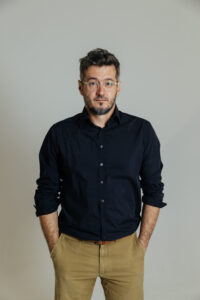
Martin Piaček (1972) is a prominent figure in contemporary Slovak sculpture. Although his work extends into other areas of visual art (such as performance and video/photo documentation), sculpture remains his primary medium of expression. One of the defining principles of Piaček’s work is the connection between personal experience and collective memory. His works often address questions of national identity, historical memory, nationalism, and patriarchal models of behaviour. He frequently engages with figures of national heroes (such as Milan Rastislav Štefánik and Ľudovít Štúr) or with iconography and symbols linked to official history, which he reinterprets in new contexts.
An important aspect of his practice is research and detailed historical study. Rather than treating history as a closed narrative, he approaches it as open material that can be reassessed and questioned (e.g. the ongoing cycle The Greatest Blunders of Slovak History). Another characteristic feature is his work with appropriated objects—often reusing existing historical artefacts (e.g. Touching the Hero, Self-Portrait as a Bust of M. R. Š.).
The currently presented work from the Marble series confirms that sculpture remains his foundational medium, to which he repeatedly returns. Despite the availability of modern technologies, he chooses the slow, manual process of carving into stone. In an age of rapid production, this slow work appears almost as a form of luxury. The physical effort of the artist remains present in the piece as an important trace, based on direct contact between the sculptor’s body and the material. Piaček’s process reflects a broader perspective on humanity’s relationship to labour and raises questions about work as a foundation of social order. The final form thus appears as a fragment of the artist’s persistent effort recorded in stone.
Piaček’s work represents a continuous attempt to critically reflect on what sculpture means today, who public space belongs to, and how collective identity is constructed within it. He studied at the Academy of Fine Arts and Design in Bratislava under Juraj Bartusz and Jozef Jankovič, where he later became a lecturer. Since 2017, he has led the Studio vvv (visual – verbal – public). Alongside his artistic practice, he actively engages in discussions about the nature and function of contemporary sculpture in public space (initiative Public Pedestal). He is involved in the project Liquid Dogmas and is preparing the lecture series Soft Norm. He is also one of the founders of the exhibition format DiStO (Theatre of the Static Object). His works are regularly presented in solo and group exhibitions both in Slovakia and abroad.
Simona Pallesichová