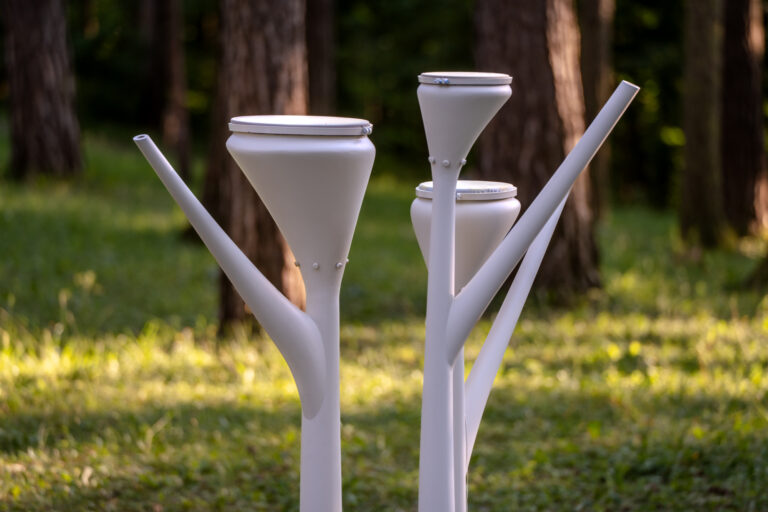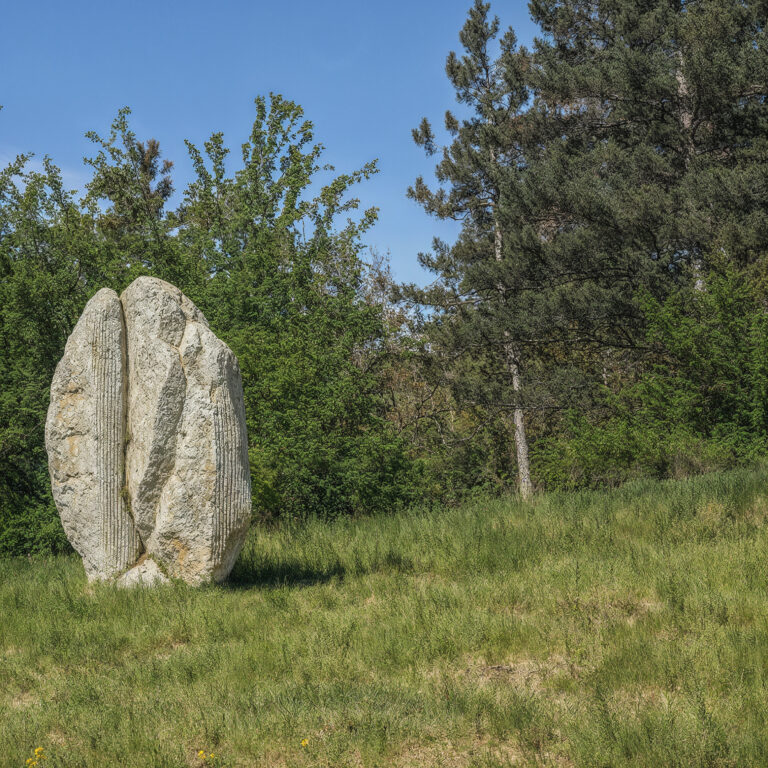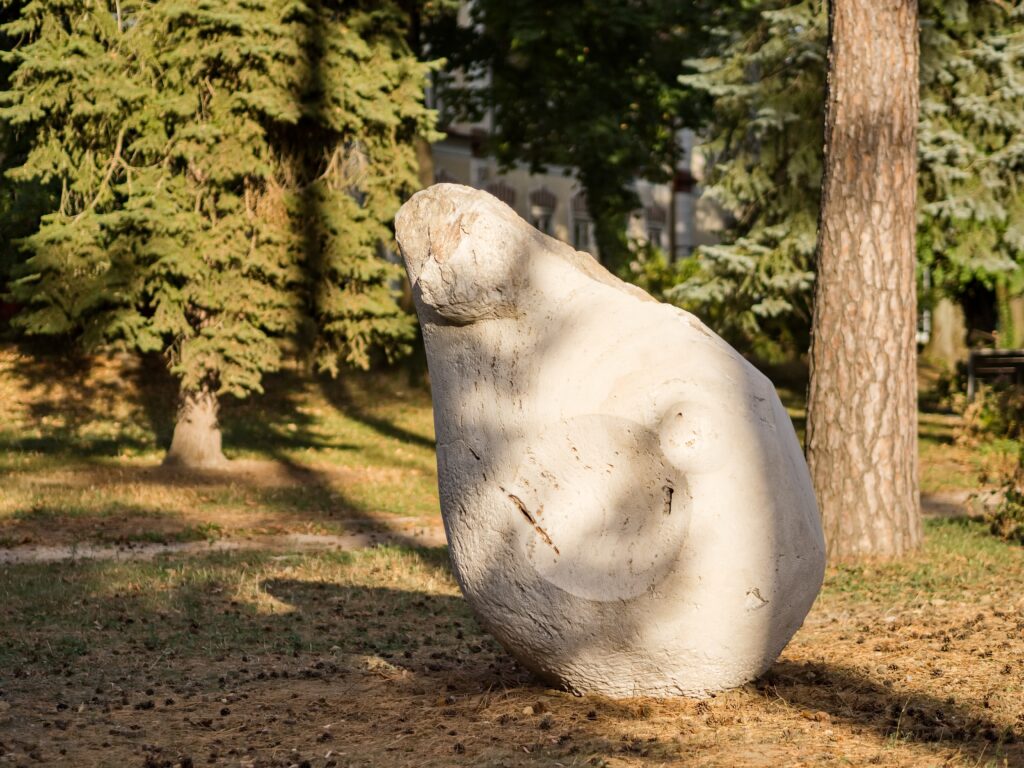
Two oversized travertine figs, two seemingly forgotten sculptural objects, or perhaps ones that fell from somewhere by accident, lie beneath the pines in the park by the train station. These carved figs stem from sculptor Martin Piaček’s long-standing interest in the fruit and tree of this plant. The fig tree did not originally grow in Slovakia; with the gradual shift in climate, however, it is becoming increasingly common, and not only in the south of the country. Sculptor and teacher Piaček keeps an orchard in Rajka, where he grows figs himself – his relationship to the subject is thus bound up equally with personal fascination, practical use, and environmental concern.
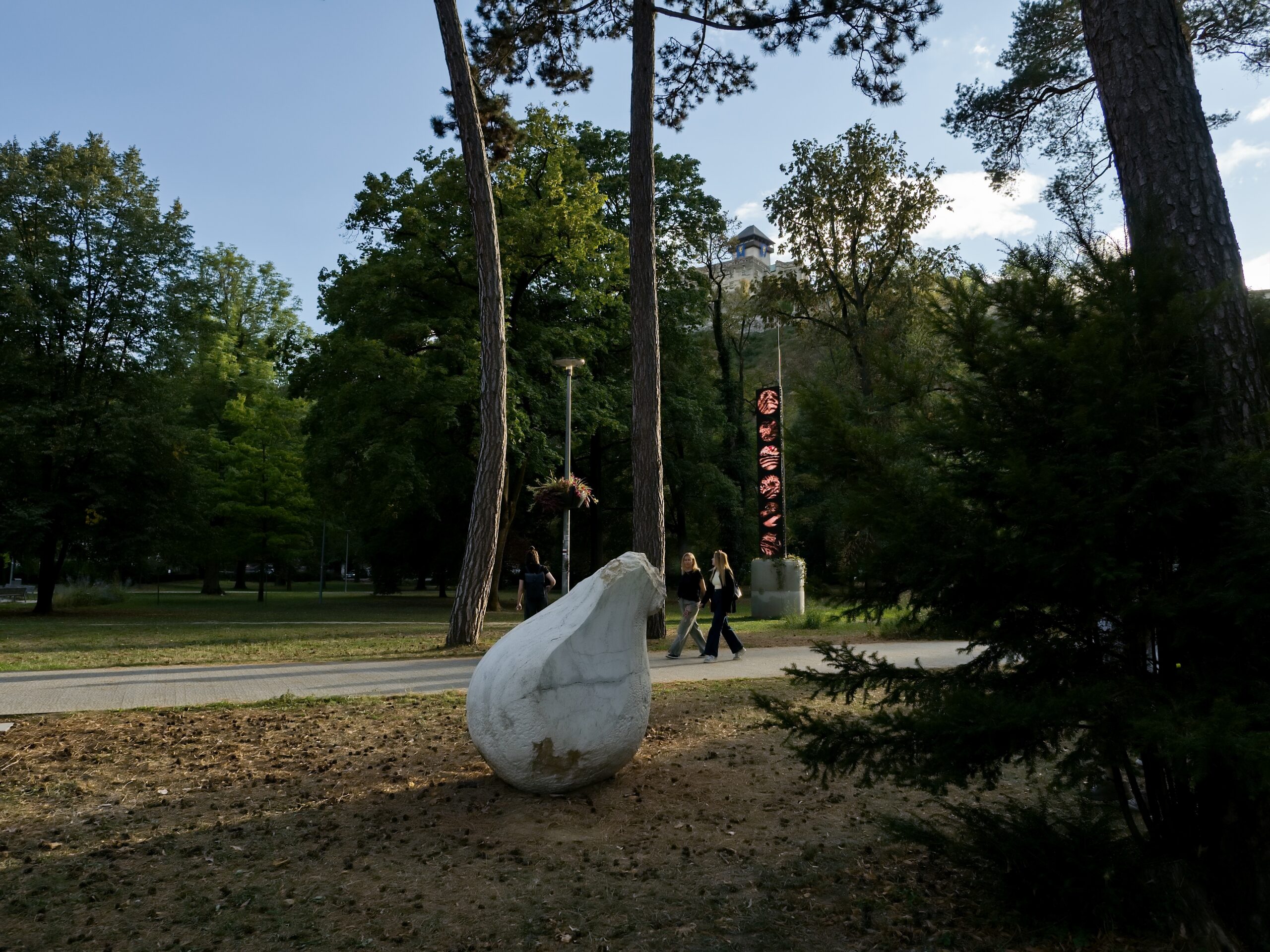
Location: Park M. R. Štefánika, Trenčín
The European continent is warming faster than any other, and as years and summers grow steadily drier, the fig is becoming a kind of superfood here in Central Europe too, one that withstands parched land. The fig – likely the oldest domesticated crop* – can grow even in places where the constant presence of water seems impossible, and neither a lack of soil nor rock will stop its roots from spreading. It is no accident that this soft, juicy, biblical fruit is transformed here into two stone, all-resistant travertine objects.
In the context of our country, figs represent both a dream and a threat. The change the fig symbolizes is not only the story of a Mediterranean summer that now allows exotic fruit to be grown in a Central European garden. It is also the story of increasingly unstable weather, heat, drought, and the social turbulence that climate change brings with it. The presence of stone figs on the lawn thus carries a paradox within it: fascination with the beauty of a fruit that is becoming ordinary because of a climatic shift, and unease about where that shift is heading.
Martin Piaček (1972) is one of the leading figures in contemporary Slovak sculpture, though his work also extends into performance, video, and photography. In his pieces he links personal experience with collective memory, addressing questions of national identity, historical memory, and nationalism, often working with figures of national heroes such as Milan Rastislav Štefánik and Ľudovít Štúr. For him, history is not a closed story but an open body of material to be reassessed – as seen in his ongoing cycle The Greatest Blunders of Slovak History. Another characteristic feature of his work is the use of appropriated historical objects, as in the cycle Touching the Hero. In the Marble series, he returns to sculpture as his fundamental medium, choosing the slow, manual process of carving into marble, in which physical effort remains present as a trace of the direct contact between the sculptor’s body and the material. He studied at the Academy of Fine Arts and Design in Bratislava, where since 2017 he has led the vvv Studio (visual – verbal – public). Alongside his own work, he is actively involved in discussions on sculpture in public space, is a co-founder of the exhibition format DiStO, and takes part in the projects Liquid Dogmas and Soft Norm. His work is regularly presented at solo and group exhibitions both in Slovakia and abroad.
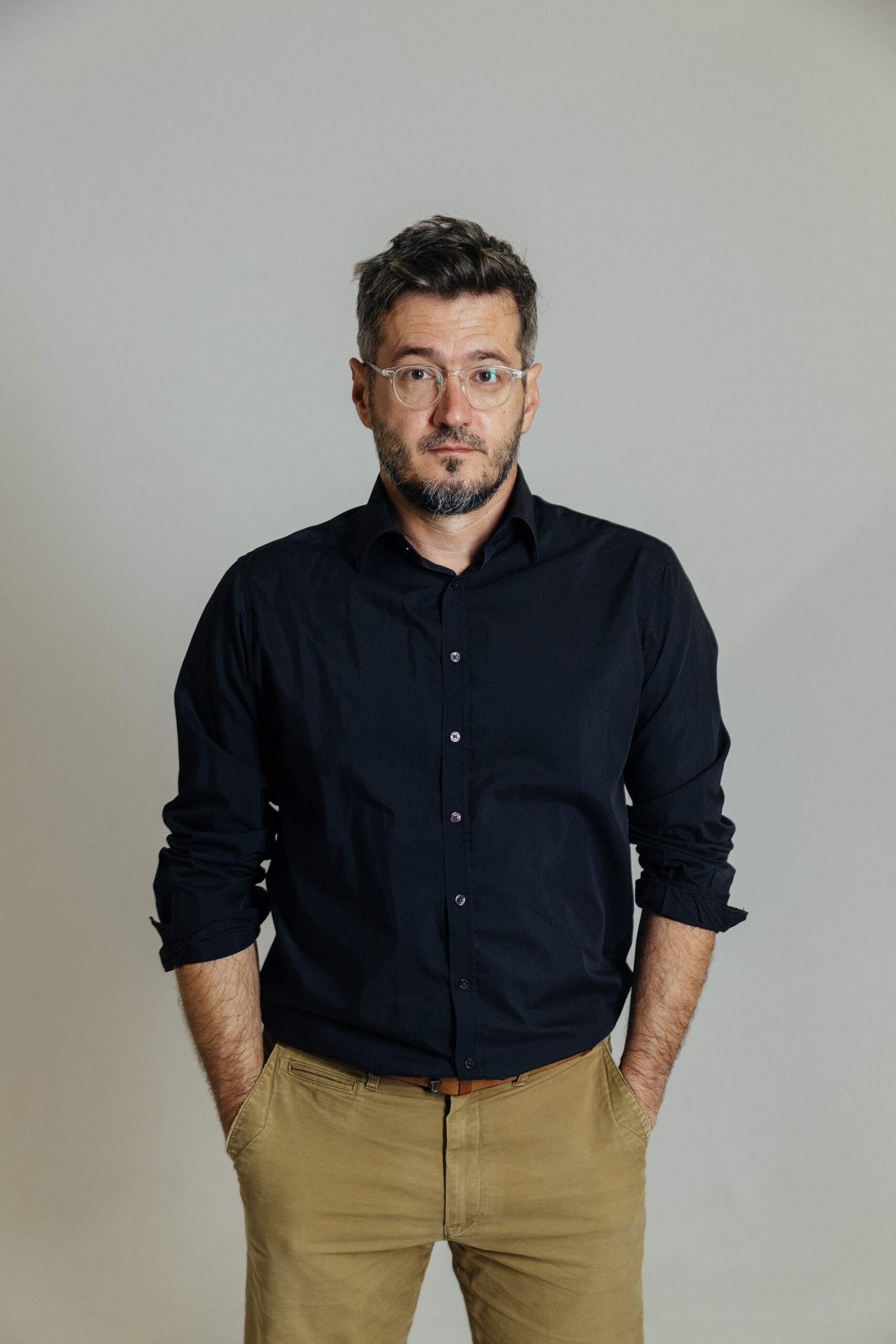
-
Researchers have found evidence that fig trees may have been domesticated in the Near East around 11,400 years ago – roughly a thousand years before wheat, barley, and legumes. The findings come from carbonized fig fruits found at Gilgal I, an early Neolithic village in the lower Jordan Valley. https://pubmed.ncbi.nlm.nih.gov/16741119